
Active travel
Infrastructure and improvements to encourage and enable more walking, wheeling and cycling.

Many journeys of these lengths are well-suited to active travel: walking, cycling and wheeling.
Encouraging active travel
Active travel is affordable, delivers significant health benefits, has been shown to improve wellbeing, contributes to a reduction in traffic congestion, indirectly improves air quality and has no carbon emissions at the point of use.
The Government has published its Gear Change vision, coupled with new guidance on Cycle Infrastructure Design and created a new executive agency Active Travel England to distribute active travel funding and oversee delivery.
Through these steps, Government has made clear to local authorities its expectation that quality infrastructure should be provided to enable people to make more of their local journeys by walking, wheeling or cycling, helping also to deliver the broader objective of a reduction in transport-related emissions.
West Berkshire Council aspires to create joined-up local networks and providing a lasting legacy of greener, safer transport.

- additional cycle parking in a number of our towns and villages
- exemptions for cyclists in one-way streets
- converting advisory cycle lanes (broken white line) to mandatory cycle lanes on the A4 through Thatcham (marked by a solid white line, which motor vehicles are not allowed to enter except in an emergency)
- extension of the Eling Way rural active travel route
In addition, we consulted on new parking restrictions and other physical measures to improve existing cycle routes, and creation of a quiet rural route via Lawrence's Lane, close to Thatcham. Our Active Travel Heat Map consultation gave residents the opportunity to identify other locations in local neighbourhoods where active travel improvements, such as new cycle parking, could be of benefit.
West Berkshire Council emphasises the importance of all users being considerate when using the Highway and following the Highway Code.
Local Cycling and Walking Infrastructure Plan

 Local Cycling and Walking Infrastructure Plan (LCWIP) [15MB] (LCWIP), adopted in June 2021.
The LCWIP identifies joined-up strategic routes for cycling, walking and wheeling that the council aspires to create over time, subject to availability of funding for design and construction. The focus for the LCWIP is on the district's main urban areas, reflecting the national objective of encouraging active travel for short distance urban journeys.
The LCWIP provides the framework for significant investment in infrastructure and supporting schemes. This framework has underpinned the council's construction of upgraded walking and cycling facilities along A4 London Road in Newbury, along the A4 through Thatcham and in A4 Western Avenue in Speen, and other initiatives such as School Streets.
You can find out more about school streets and cycleway/footway improvement schemes on the pages listed at the bottom of this page.
Delivery and development

In addition to the above schemes, using Active Travel funding, the council has also:
- constructed Stage 1 of the Stockcross Linkway shared-use path, between Stockcross and the A4
- constructed the Crown Mead scheme in Thatcham
- introduced additional School Street schemes at Francis Baily School in Thatcham and Springfield Primary School in Tilehurst
- made alterations to enable considerate shared use by pedestrians and cyclists on Lower Way, Thatcham
- carried out an in-depth study and prepared designs to improve the pedestrian and cycle connection between Theale and Calcot
- assessed scope to improve active travel routes adjoining Robin Hood Roundabout
- developed plans for Stage 2 of the Stockcross Linkway, intended to connect into the wider Newbury area network via Speen Lane
Current schemes
Find out more about our current and recent school streets and other active travel schemes on the pages below.
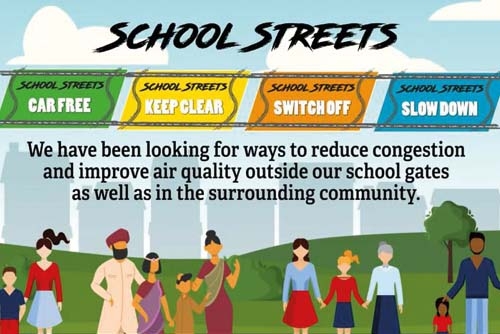
School Streets Schemes
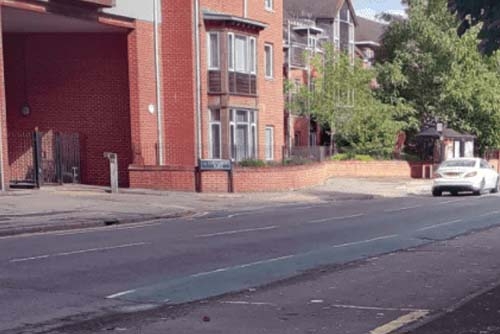
Cycleway and footway improvement schemes


